
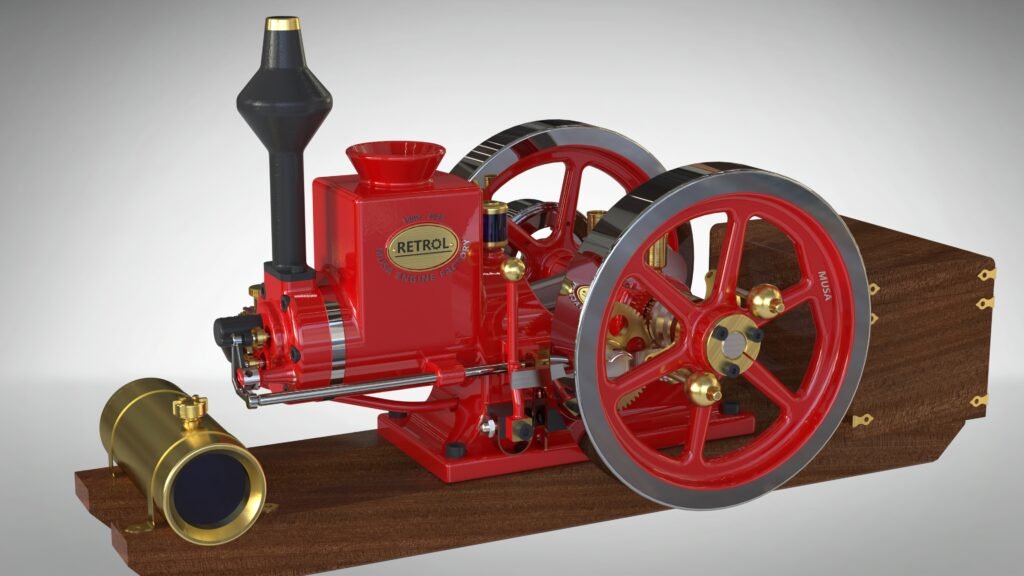
In the age of roaring machines, countless inventions shaped industrial progress. Among them, the Hit and Miss Engine stands out for its distinctive function and enduring mechanical charm. Still admired by enthusiasts today, it is often referred to in Chinese as the “intermittent engine” or “flywheel engine”.
I. What Is a Hit and Miss Engine?
The Hit and Miss Engine is an early internal combustion engine, usually single-cylinder, controlled by a speed governor.
– A “Hit” occurs when the engine fires, generating power.
– A “Miss” happens when no power is needed; the engine skips the power stroke and coasts on flywheel inertia until speed drops and another “hit” is triggered.
This intermittent operation improves fuel efficiency and speed regulation at low loads. Its oversized flywheel is key to smooth performance during idle cycles.
II. Origins and Historical Significance
Emerging in the late 19th century, the Hit and Miss Engine was a response to industry’s need for reliable, economical power.
Early Developments: Before its invention, engineers explored gas-powered engines, such as those by Lenoir and Otto. These early designs proved the potential of internal combustion, despite being large and inefficient.
Innovation of the “Hit and Miss” Concept: The governing system addressed inefficiencies under varying loads by allowing engines to skip power strokes when not needed. Though its exact inventor is unknown, multiple manufacturers adopted the design around the same time.
Rural Applications in America:
– Pumping Water: Powered irrigation and livestock wells during droughts.
– Grinding Grain: Ran mills that reduced labor and boosted efficiency.
– Mechanizing Tools: Belt-driven farm tools like threshers and cutters improved productivity.
Urban and Industrial Roles:
– Workshops: Powered saws, lathes, and other machines.
– Electricity Generation: Drove generators before widespread electrification.
– Construction Equipment: Powered mixers and hoists on building sites.
– Small Boats: Served as auxiliary power for barges and fishing vessels.
III. Modern Legacy: From Practical Tool to Collector’s Item
- Museums and Exhibitions
Institutions like the Coolspring Power Museum in Pennsylvania preserve operational examples to showcase early mechanical engineering.
Website: coolspringpowermuseum.org
- Collectors’ Market
Well-maintained engines can sell for thousands of dollars. Enthusiasts value their unique mechanics and aesthetic.
- Educational Tool
Used in engineering education to demonstrate ignition, throttle control, and energy transfer.
- DIY Hobby Projects
Functional scale models provide hands-on learning and restoration challenges for hobbyists.
Conclusion
The Hit and Miss Engine is more than a mechanical relic—it’s a symbol of industrial creativity and perseverance. Its iconic rhythm “pop… (pause)… pop…” evokes an era of innovation and determination. Even today, it inspires curiosity, craftsmanship, and respect for the engineering pioneers who shaped our world.
